
Europe’s Witch Fever: The Causes of the Witch Hunts
Welcome back to our ongoing discussion about the history of witches in early Modern Europe. Today’s bit is the second part of our three-part series. Last time we looked at a definition of who, or what, a witch was along with where in Europe the idea of a night-flying, child-abducting, satanic witch was born.
This week we will look at the larger scale historical contexts surrounding the witch hunts. Our time period of 1400 to 1775 had many large scale social, political, and economic factors developing which changed the world, and the way it was perceived, for many throughout the continent. This post, then, will look at what I feel are the five most impactful developments in this time that shake the world of an early modern European. Our next and final post will discuss three cases dealing with witches of this time and place and use the info from this post and the previous one to contextualize those cases and help us to understand some of the why about them.
I do want to note that the factors we talk about today are very large and have many elements that tie into them, some that even could be discussed here but won’t necessarily be discussed. This is not meant to be a comprehensive look at these large-scale developments, think more of quick survey of them and how they tie into our understanding of the how and why of this witch craze.
Before we investigate the causes of the witch craze, if you like what we are doing here you can support the Museum here. You can also follow us on Facebook and Instagram. Or you can join our mailing list below!
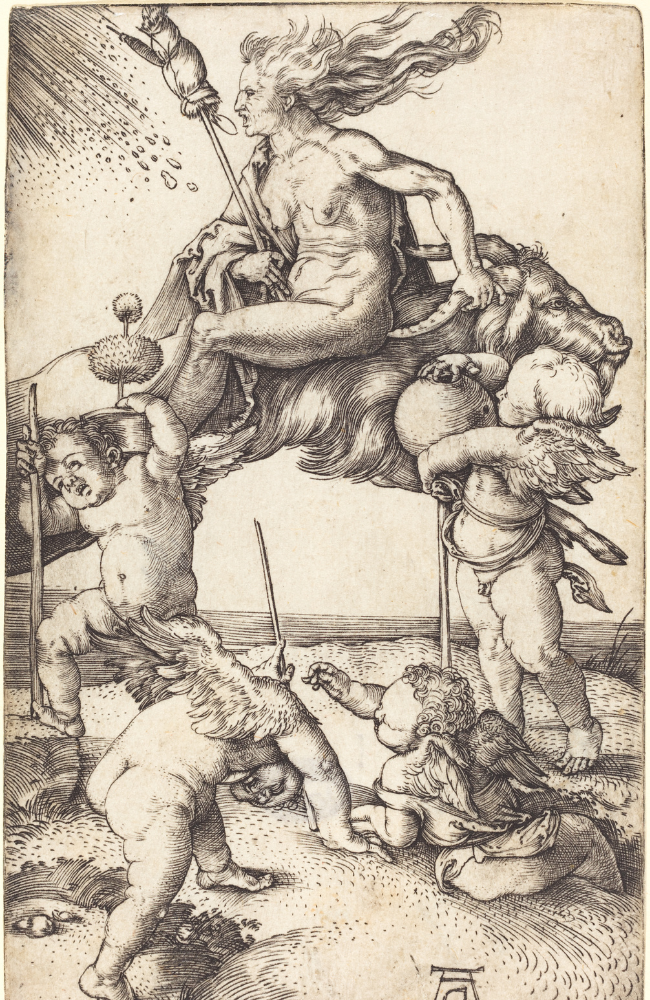
This work from famous German Renaissance artist Albrecht Dürer gives us a nice reminder of what a witch looked like to the Europeans of the time.
What caused this witch craze?
For those of you who remember your high school world history or college survey classes, the time period of the 1400s up to the 1800s has a lot going on, especially in Europe. This is the timeframe where we see the rise of Europe as the predominate political and economic power in the world as kingdoms such as England, Spain, and France, build massive overseas empires that will only further their military and economic might. And, of course, back home for them there are also plenty of political and social developments that help to direct them in their actions on the world stage.
However, amongst the multitude of elements at play in Europe, and the world at large, I think there are five that have the most impact on fomenting this nearly four century long witch craze. Now, that is not to say that other elements not discussed in depth here, such as the beginnings of globalization and cross-Atlantic trade, did not have a role to play in this witch craze, I just think their impact is less than the five that we will discuss. That being said, these five are not in any specific order of importance. Lastly, to help fully frame these we will want to consider the effects these events have on your everyday person. Not the kings and queens of Europe, but instead the ox-herder and local merchant.
The Reformation
The first one up is the Reformation. Martin Luther’s pinning of the 95 theses to the door of the cathedral in Wittenberg had many wide-ranging implications across not just the religious, or the political, but also economic (as we shall see) and social. Prior to the Reformation much of Europe was Roman Catholic (and we will take a moment to fully recognize Orthodox Christianity in much of Eastern Europe). As such, the Catholic Church and the Pope had massive power, and not just religiously but also politically and economically.
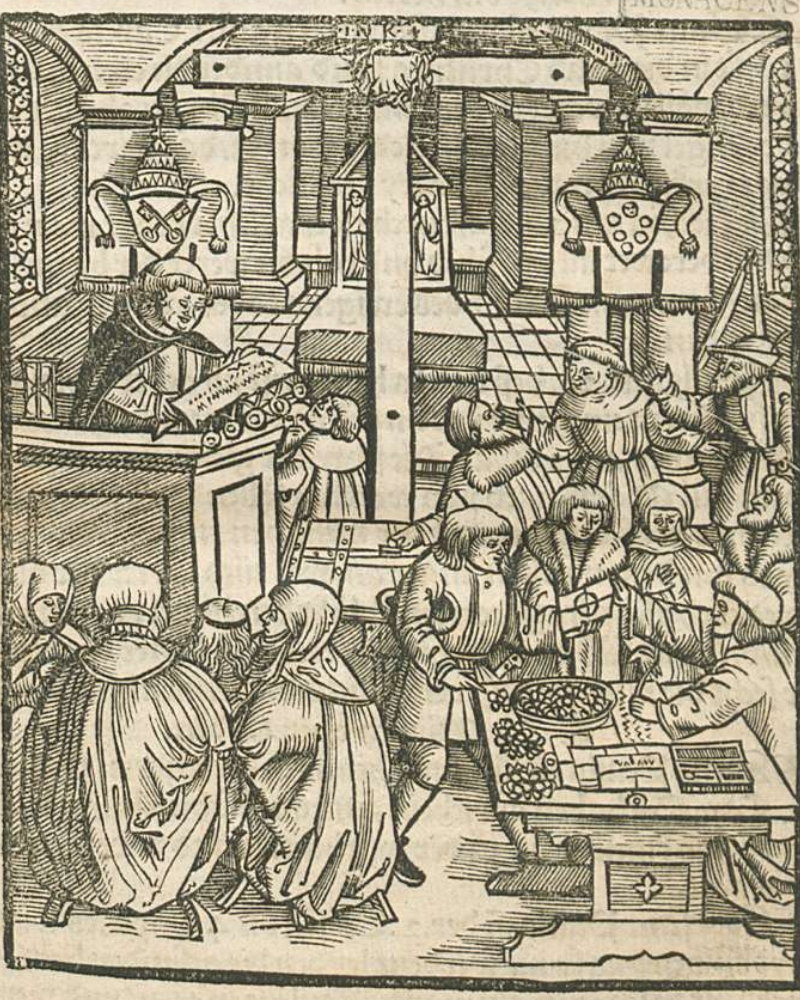
The selling of indulgences was the primary point of contention Luther had with the Church’s corruption. His 95 Theses probably were not meant to incite a religious, and perhaps even political, revolution, but, they did.
The Church at this time was the leading land owner in Europe with monasteries and churches owning land in practically every village, town, and city. This land ownership gave the Church massive political and economic power to pair with its religious power. Peasants were expected to work Church lands alongside their own if the Church owned farm land in their village or town. They also were required to pay tithes, essentially taxes, to the Church. The Pope also directly ruled over lands in Italy at this time known as the Papal States, meaning alongside running the largest Church in Europe, the Pope also ran a country. The Church also has a positive feedback loop set up with the kings and other royalty in Europe in that by supporting the Church and its rights to the land and tithes, the royalty would be given recognition and legitimacy by the Church. To say the Church was the most powerful entity in Europe come the 15th century is no understatement.
The Reformation shatters this entire system of power the Church had. As some of the princes and kings of Europe leave the Church and adopt Lutheranism, and some even Calvinism a bit later, these lands and rights the Church had claimed in some areas wither alongside the spiritual reasoning for the Church. For most people in the mid-1400s religion was mildly abstracted to them as it was difficult to obtain spiritual knowledge. You know it comes from the Bible, but the Bible is written in Latin, a language that you as a German peasant or a French merchant cannot read or speak. So, to learn the lessons of the Bible and gain spiritual guidance you must go to Mass on Sunday and listen to the local priest give you second-hand knowledge and learnings. The Reformation changes this entirely. For Protestants the Bible will become available in the vernacular meaning those that could read, literacy rates were still very low, but as we will see, that will change, could gather their own spiritual knowledge now. Pair this with new teachings from other trained religious men and the spiritual guidance of Europe is shattered and lost.
For the many who lived in this time period these changes are massive. Generation upon generation had lived and filled much the same roles as those who came before them. Now their religion could change and they had to learn a new way different from their heirs. Religion was not just passed down from generation to generation, but also from sovereign to subject. Royal families will have changes in religion from father to father, meaning those living in their realms will have to adjust and change with them. Catholic one generation, perhaps Calvinist or Lutheran the next. These changes will introduce a new type of anxiety and uncertainty to Europeans. When the world presents troubling and difficult times, which this time period will definitely do, where do you look for guidance? The stability the Church had provided for centuries is gone for millions.
Beginnings of Capitalism
With spiritual guidance removed, let us introduce one of the grand changes of European history by looking at the beginnings of capitalism and the changing of European economics. In the mid-1300s Europe was ravaged by the Bubonic Plague. Scholars estimate that 1/3rd of Europe’s population is killed by this affliction. That is going to have massive economic impacts, because now we have removed 1/3rd of the labor pool. This started a series of knock-on effects where previously European societies had been labor rich and capital poor, but due to the massive cut in the labor pool the balance began to change. Peasants and town laborers become (slightly) wealthier as their labor is worth more. Over the generations this would continue and we see the build up of more wealth in families, which eventually allowing wealthier merchant and peasant families to become a sort of proto-middle-class. And then over the course of this same timeframe of witch hunts, this proto-middle-class would become the middle-class.
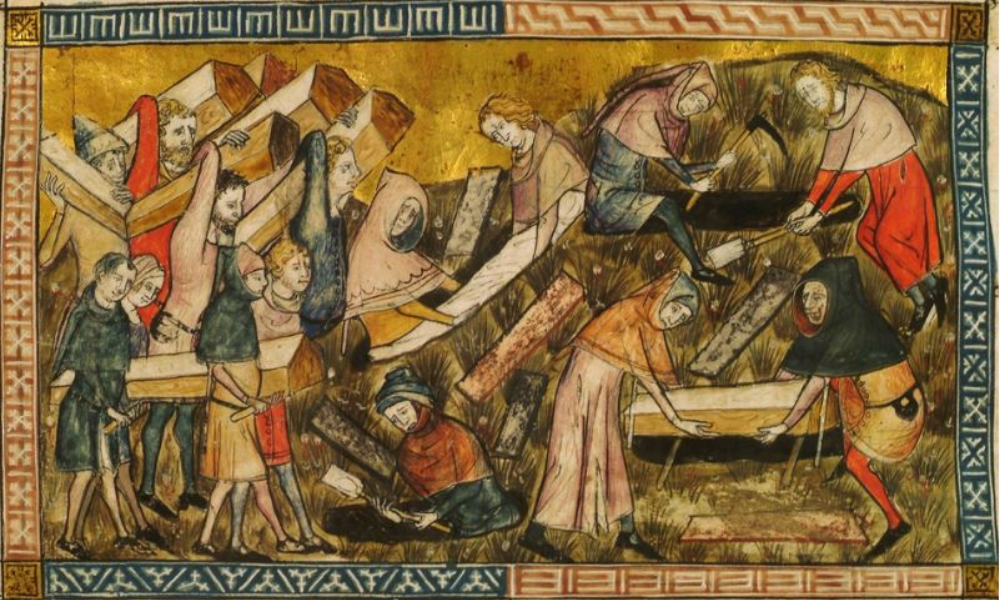
This miniature by Pierart dou Tielt depicts the citizens of Tournai disposing of plague victims. While the economic impacts of the plague are not often talked about, they are important here for our story about witches of all things.
With the birth of a new socio-economic class that means a restructuring of social roles. Who does what in the town would change and that would impact your day-to-day goings. For example, women, who had filled roles such as being midwives and healers, would see their roles change. Their labor is now needed elsewhere. The social prestige then that comes with a role such as being a local healer is lost because they are no longer around or present. Who you are in the community changes as the economic relationships change. This is also where things such as cross-Atlantic trade will impact people with new crops that fundamentally change the needs of those farming. Remember, for your normal person life has not changed much from generation to generation in the preceding thousand or so years, and now social roles as defined by both micro- and macro-economics will change relatively rapidly. This once again allows anxiety and an uncertainty to creep in.
Centralization of the State
To pair alongside economic reorganization, most people of early modern Europe also had to contend with a political restructuring that was beginning. The feudal hierarchy had been the dominant structure of peoples’ lives for centuries.[1] However, as the centuries move, the relationship between peasant and sovereign changes more to a relationship between citizen and administrator. Monarchs, most notably in the form of the Sun King, Louis XIV of France, begin to reign in the powers and freedom of the lords underneath them to create a more centralized, and for their purposes more efficient, state. What is normally talked about at a higher political level of the reorganization of countries and kingdoms does have a trickle-down effect and will influence the day-to-day lives of your normal person.
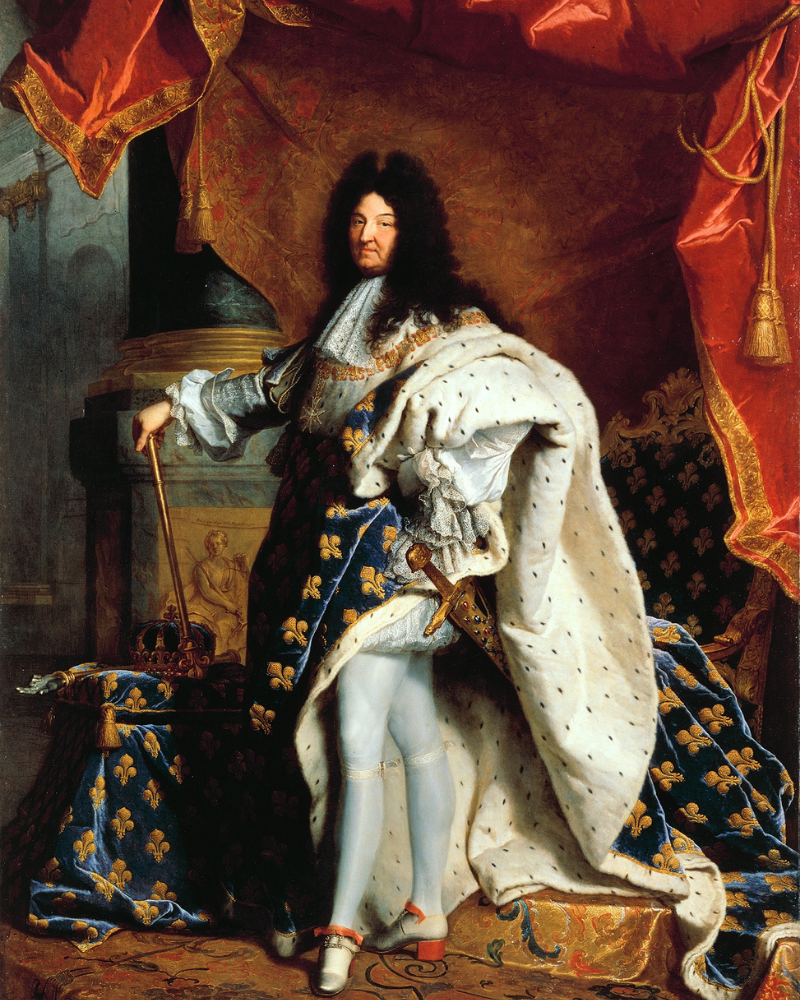
Louis XIV of France is the quintessential example of a centralizing king. He moved his nobles to Versailles, created a more efficient taxation system, and used this all to wage a lot of wars in Europe.
Previous to this centralization, the general scope of how you as everyday peasant or townsfolk interacted with your king (or prince, or duke for larger ‘states’) was through a local lord. You paid your taxes to the lord, who would then pass those along to the nobles above him. Your legal complaints were adjudicated by the local lord. If you were called to arms, you served under a banner of your local lord. You were separated from the king by your local lord. This made local politics and the understandings of kingdom more personal and also more distant. The king in this way could be almost mythologized at times as a righteous figure above the corruption of his nobles and if he just knew of these injustices, he would right the system quickly. This obviously is not how kings acted or would act though, unless really pressed by the clear violence of a peasant uprising. What the king would see instead is a system rife with inefficiencies and blocks to his royal power. He saw a taxation system that did not give him the full amount he thought due to him, lords being able to rise up against him or refuse his call-to-arms. He saw a system that was more personal and therefore trickier to navigate.
So, in the 1500s then centralization of power begins to appear in European countries. This is done through various royal decrees and passing of laws that would take away those personal elements. Taxation would be carried out by direct agents of the crown, not collected by the lord and his men. This was due to the need for a professional army with regular training and material support. These changes to complex systems brought the citizens of these lands much more directly in line with, and under the influence, of their king. Rights were stripped at times if it would benefit the king and they felt they could handle the pushback. Previously, a peasant who felt they were taxed too much by their lord could have the hope to appeal to a righteous king who would right this wrong. But what does one do when it’s a direct agent of the king collecting the exact same tax? Yet further anxieties for people who had had generations of stability.
Printing Press and Rising Literacy
By 1450, Johannes Guttenberg had introduced the moveable type printing press to Europe, and the history of writing was changed. Books previously were items of some rarity due to the process for their creation. The meticulous process of copy or handwriting out every word in a book made their creation slow and arduous. Guttenberg’s invention would substantially speed up the process. With that, books became more widely available than ever before. This increase in the availability of books meant, eventually, an increase in literacy rates across Europe.
How this connects to the witch craze though, comes in the form of a very specific genre of book that gains popularity in the first couple of centuries following the invention of printing presses. Demonologies are writings by priests and theologians detailing the acts, powers, and characteristics of Satanic forces, like witches. These books were some of the highest selling books available in early modern Europe.[2] Historian Lyndal Roper points out that demonologies played multiple roles in the European landscape. They were theological and legal writings but they also filled the role of entertainment.[3] These books as entertainment then began to help build and solidify the ideas and understanding of the witch. How someone would think about, talk about, write about, and act upon a witch was very much influenced by these books. The most notable of these writings is the infamous Malleus Maleficarum by Heinrich Kramer. Kramer’s work details theories about witches, how to find a witch, and, since it was meant to be a legal guide, how to prosecute and execute a witch. It was the equivalent of an international best seller in its day with there being 28 editions of the book printed in 114 years! As we shall see next week these demonologies had a direct impact in guiding the actions of those who found themselves in a witch hunt (or even created the witch hunts themselves).
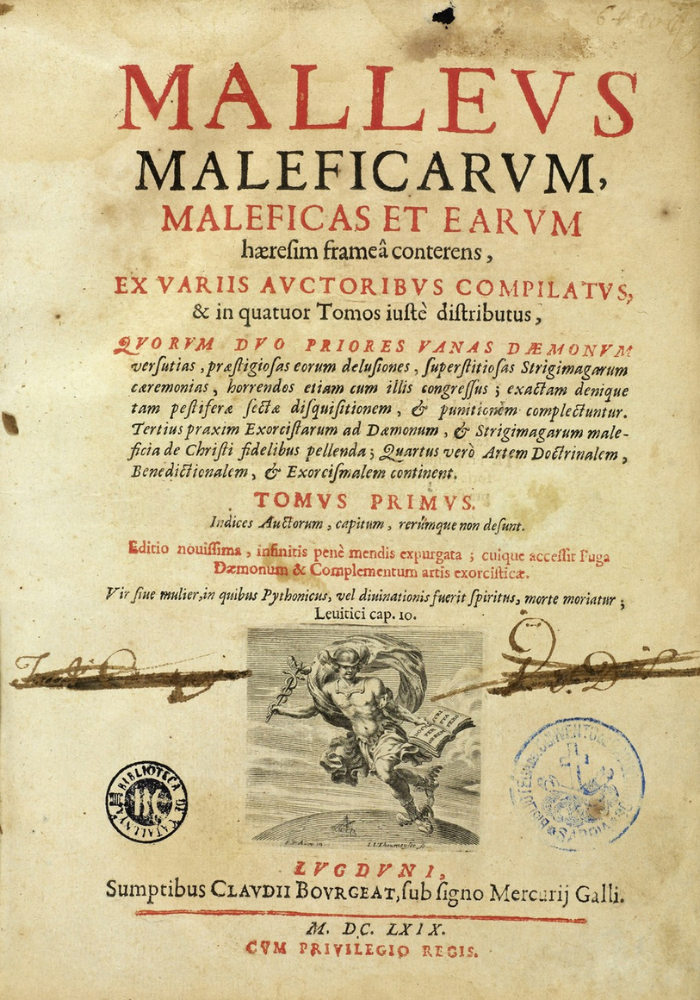
The Malleus Maleficarum, or as it is sometimes known in the English language as the Hammer of the Witches, is probably the best known of these demonologies, but it was definitely not the only one! The same King James who sponsored the Biblical translation also authored his own demonology.
War
Our last factor for consideration here is war. With many of the previous factors we have discussed, the anxiety caused by them helped to drive witch hunts. And I can think of nothing more anxiety inducing than war. Early modern wars in Europe were massive points of instability, with large military forces, heavily composed of mercenaries, trampling across fields and causing or exacerbating famines for local populations. Let’s use two specific examples of wars to help clarify how witch hunts could brew amongst local populations.
Beginning in 1618, the Thirty Years War (1618-1648) is considered the last of the major Wars of Religion in Europe, at its most basic it is a war of Protestants versus Catholics across the continent. That is a very oversimplified set up of it politically and religiously, however, I want to bring up this war because of the destruction it caused and the general sense of anxiety it could cause. First off, the Thirty Years War had a massive toll in lives. Scholarly estimates range from five million to nine million civilians and soldiers dead. The vast majority of the conflict occurred in what is modern day Germany and estimates put the German population as declining anywhere from 30-40% by the end of the fighting. Those are just the numbers, but the actual events that individuals faced daily would have made this war seem like the apocalypse was brought to bear on them. Mercenaries played a heavy role in the fighting and would at times switch sides depending on who could pay for their services. And when they couldn’t secure pay, they would rove the countryside as brigands searching for food and shelter, terrorizing the local populaces. The German lands had been suffering a long drought and famine before the war began, and soldiers marauding through the fields only kept this famine going. To pair alongside the violence and lack of food, the political complexities of the war meant that at various points Catholics and Protestants were fighting alongside each other against Catholics and Protestants. To your average burgher or peasant nothing was certain except for death and destruction. It should be unsurprising then to note that some of the largest witch hunts in German history, such as the Wurzburg and Bamberg hunts, happened during the war.
Our second example is the English Civil War (1642-1651). This conflict fought over the primacy of the king and parliament saw many substantial changes to the social and political landscape of the British Isles. Most notably, this is the time when Scotland and Ireland are incorporated into the English state, leading to the founding of the United Kingdom, and the execution of Charles I by Parliament. The reason I bring up the English Civil War specifically is it is an excellent example of how during a civil war the government will be absent in many regions. And even if governance is present in a region, it may still be absent in full capabilities, such as legal prosecution. The greatest bit of witch hunting in English history came during this time due to that lack of governmental presence.
Those are my five factors that drove the fevered witch hunts of early Modern Europe. Next week in our final part of this blog series we will dive into three short case studies to show how witch hunts manifested and specifically how these five factors played into them.
[1] Going to get ahead of the potential complaints here, but yes, we are aware that the term or idea of feudalism is a bit iffy with English-speaking historians. But as a very broad set up for speaking easily of multiple different socio-political systems we’re going to run with feudal/feudalism in its broad, generalized form. If you’re interested in knowing some of the reasons for the scruples about the term, I suggest reading this post from Dr. Charles West giving a brief insight into why it’s a contested term.
[2] The best-selling books of the time were all religious in nature, but the primary movers outside of demonologies were actually the writings of Martin Luther. This of course, helped to further spread the Reformation and ties right back in with our previous point!
[3] Lyndal Roper, “Witchcraft and the Western Imagination,” Transactions of the Royal Historical Society 6, vol. 16 (2006): 117-141, https://www.jstor.org/stable/25593863.
